


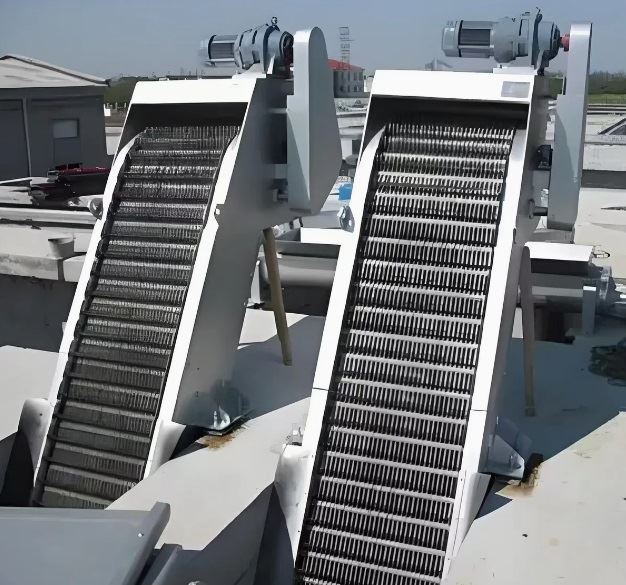

What is Mechanical Bar Screen?
A mechanical bar screen is an automated wastewater treatment device designed for intercepting and removing large impurities, floating substances, and suspended solids in sewage. Unlike manual screens that require human labor to clean, mechanical screens use a motorized mechanism to continuously or periodically clear debris from the bars.
It is the standard first step in large-scale municipal and industrial wastewater treatment plants, serving as the primary defense against equipment damage.
As a critical front-end protection barrier in sewage treatment processes, the mechanical bar screen in sewage treatment plants is engineered to intercept and remove large floating debris, suspended solids, and foreign objects (such as plastics, branches, and industrial scraps) from incoming sewage. By blocking these harmful impurities before they enter subsequent treatment units, it effectively prevents clogs in pipelines, damage to pumps, and malfunctions in filters-laying a solid foundation for the stable and efficient operation of the entire sewage treatment system. This mechanical bar screen is widely applicable to municipal sewage treatment plants, industrial wastewater pre-treatment workshops, and environmental remediation projects, adapting seamlessly to both continuous and intermittent operation demands.

How Does Mechanical Bar Screen Work
The mechanical bar screen in sewage treatment plant operates based on a sophisticated rake tooth transmission & differential self-cleaning mechanism. A set of high-strength rake tooth assemblies are evenly mounted on a closed chain track. Driven by a high-torque motor and reducer, the chain track runs stably along the guide rail under the traction of sprockets.
When sewage flows through the bar screen area, the parallel vertical bar racks (with adjustable spacing of 1mm, 3mm, or 5mm) intercept solid impurities. As the rake tooth chain moves upward, the guide wheels at the top trigger a differential dislocation between adjacent rake teeth. This clever design allows most captured debris to fall into the slag collection trough by gravity. For stubborn debris adhering to the teeth, a built-in reverse cleaning brush further scrubs the rake teeth, ensuring thorough self-cleaning without manual intervention. The entire process maintains consistent water flow velocity, avoiding excessive head loss and ensuring efficient sewage treatment.


Technical Specifications of Mechanical Bar Screen
|
Model |
COY3 |
COY4 |
COY5 |
COY6 |
COY7 |
COY8 |
COY9 |
COY10 |
COY11 |
COY12 |
COY13 |
COY15 |
|
Installation angle |
60-80° |
|||||||||||
|
Power kw |
0.37 |
0.37 |
0.55 |
0.55 |
0.75 |
0.75 |
0.75 |
1.1 |
1.1 |
1.1 |
1.5 |
1.5 |
|
Speed |
2 |
|||||||||||
|
Channel width mm |
400 |
500 |
600 |
700 |
800 |
900 |
1000 |
1100 |
1200 |
1300 |
1400 |
1600 |
|
Canal deep |
1000-12000mm |
|||||||||||
|
Equipment wide mm |
300 |
400 |
500 |
600 |
700 |
800 |
900 |
1000 |
1100 |
1200 |
1300 |
1500 |
|
Medium temperature |
≤80 |
|||||||||||
|
Handling material height mm |
400-1000 |
|||||||||||
|
RAKE TOOTH
|
|
|
RACK AND RACK SHIELD |
|
|
MOTOR |
|


Benefits of Bar Screen In Sewage Treatment Plant
Our mechanical bar screen for sewage treatment plant is designed to solve practical pain points for sewage treatment facilities, delivering measurable value through concrete advantages:
Full Stainless Steel Construction for Longevity
All key components, including bar racks, rake teeth, and chains, are made of high-quality stainless steel. This material selection provides excellent corrosion resistance and wear resistance, even in high-humidity, high-salt, or acidic/alkaline sewage environments. The service life is extended by 30% compared to ordinary carbon steel equipment, significantly reducing replacement and maintenance costs.
Modular Rake Teeth for Easy Maintenance
Each rake tooth is designed as an independent modular component. When individual teeth are worn or damaged, they can be replaced quickly without disassembling the entire chain system. This design cuts maintenance time by 50% and lowers maintenance costs by up to 40%, ensuring minimal downtime for the sewage treatment process.
Intelligent Overload Protection to Avoid Faults
The mechanical bar screen is equipped with a dual-protection system-thermal relay for electrical overload and mechanical torque limiter. When encountering hard impurities or equipment jams, the system automatically shuts down and sends an alarm signal within 0.5 seconds, effectively preventing motor burnout and chain breakage. This protects expensive downstream equipment from secondary damage caused by debris leakage.
Customizable Design for Versatile Adaptation
The installation angle can be flexibly adjusted between 60° and 80° according to the actual channel structure. The channel width ranges from 400mm to 1600mm, and the canal depth can accommodate 1000-12000mm, adapting to different sewage treatment scale requirements. For special scenarios such as coastal sewage plants or chemical wastewater treatment, we also offer optional explosion-proof motors and anti-corrosion coating upgrades.
Applications of Mechanical Bar Screen
The mechanical bar screens in sewage treatment plants are widely used in various sewage treatment scenarios that require reliable front-end impurity interception:
* Municipal Sewage Treatment Plants: Serves as the first-line purification equipment in inlet pumping stations, intercepting solid waste in domestic sewage to protect subsequent grit chambers and aeration tanks.
* Petrochemical and Refinery Wastewater Treatment: Intercepts solid impurities encapsulated in oily wastewater, prevents clogging of oil-water separation membranes, and ensures the normal operation of refinery wastewater treatment processes.
* Slaughterhouses & Food Processing: Removes animal residues, food scraps, and fiber impurities from high-concentration organic sewage, reducing the load on biological treatment systems and avoiding pipeline blockages.
* Power Plant Cooling Water Treatment: Filters suspended solids and aquatic organisms in circulating cooling water, preventing scaling and abrasion of heat exchangers and improving cooling efficiency.
* Mining & Mineral Processing Wastewater: Separates mineral particles and sludge from mining sewage, facilitating water recycling and complying with environmental discharge standards.

Certificate


Contact Information


